


HOTEL
Today, crossing the threshold of Palazzo Ducale does not only mean staying in an accommodation structure, but reconnecting with the heritage of a noble past that has remained intact. Our rooms preserve the austere soul and original atmosphere of the eighteenth-century residence, offering an essential and timeless welcome


NAPOLEONIC FORT
It's not just stone, but the pulse of a glorious and turbulent era. Our Ducal Palace, before becoming a charming residence, was chosen by Napoleon's troops as a silent sentinel on the Riviera dei Cedri.
Imagine 1806: the scent of the sea mingling with gunpowder, the eyes of French soldiers fixed on the horizon to intercept English sails, and the echo of cannon fire still seeming to vibrate within the massive walls. Here, where silence and sea breezes reign today, the fate of kingdoms and battles was decided.
Experiencing the "Fortino" today means stepping into history. It means being enveloped in an atmosphere suspended in time, enjoying the same breathtaking view that enchanted generals and dukes. A place where every stone tells a tale of a challenge, and every sunset pays homage to the grandeur of a past that has never ceased to excite.
CONSTRUCTION:
18th Century (Catalan-Gonzaga Family)
FUNCTION:
Defensive outpost and lookout point against the English

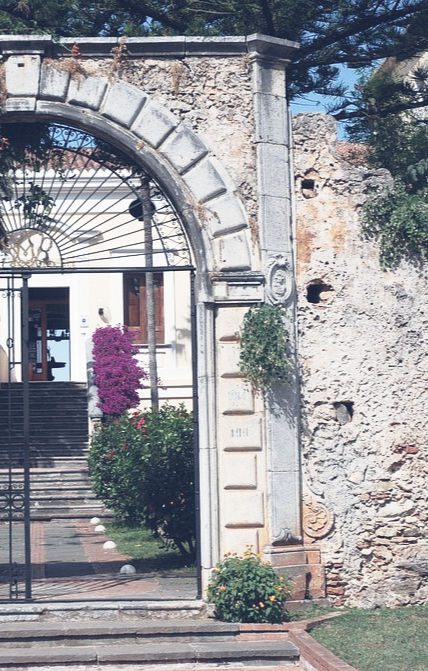


HISTORICAL ORIGINS
The foundations of the Ducal Palace date back to the 18th century, a time when the enlightened nobility sought to combine the prestige of their lineage with the wild beauty of the Calabrian landscape. Its history is inextricably linked to the Catalano-Gonzaga family, Dukes of Cirella, who built this imposing residence as a symbol of their power and their love for this stretch of coast. Originally a stately residence, the Palace was designed to be the hub of the fiefdom's social and administrative life. Every architectural detail, from the solid square plan to the spacious internal courtyard, reflected the style of the great noble courts of the Kingdom of Naples. Its rooms, once adorned with sumptuous furnishings and frequented by illustrious members of the aristocracy of the time, were the stage for a life dedicated to art, politics, and territorial governance.
CURIOSITY: It is said that the palace is connected to other structures in the area by secret passages, used by French soldiers to escape or move unseen from the coast during sieges.


RUINS OF CIRELLA
High above, dominating the promontory, stand the Ruins of Cirella, the ghostly and fascinating remains of a medieval town seemingly frozen in time. Destroyed and abandoned following the incursions of Napoleon's fleet and the English bombardments of 1806, "Old Cirella" is today an open-air museum where the castle, the Church of San Nicola, and the ancient houses whisper stories of sieges and glory.
The Ducal Palace represents the ideal continuation of this story. When life on the hill became too complex and dangerous, the nobility and local institutions moved down to the valley. The Palace is therefore not just a residence, but the direct heir of that ancient village: it was built by the Catalano-Gonzaga dukes to bring noble prestige from the hilltop to the shores of the sea.
CONNECTION: The guest who stays at the Palace can look up and physically see the place where everything started.

ROOMS
Simple and welcoming, some with sea or garden views, equipped with private bathrooms and essential amenities, ideal for couples and families.
PAST AND PRESENT
Fragments of history and current news within the walls that have witnessed the centuries.
Via Vittorio Veneto, 190
87023 Diamante CS
Tel: +39 0985 091501
Reception Tel: +39 0985 86051
booking@pducale.it
Rag. Soc.: Hotel Ducale di Gilda Ruggeri S.r.l.
P.Iva: IT01319580781
CIR: 078048-ALB-00029
CIN: IT078048A1ZK63TKLE